Can AI Detectors Spot Heavy Rewriting? The Truth About Bypassing Algorithms

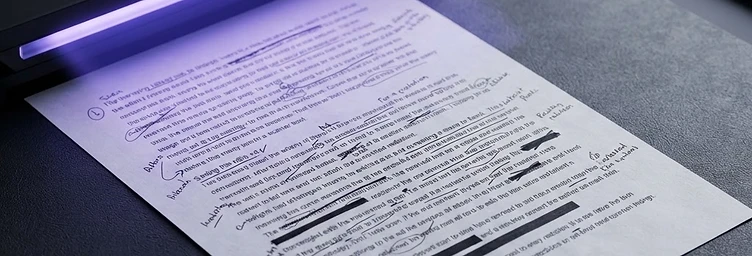
The Rewrite Illusion: Why Your Edits Might Not Be Enough
Walk into any subreddit dedicated to AI writing, and you will find the same recurring debate: "If I rewrite every sentence manually, can the AI detectors still catch me?" It is a question born of necessity for students, copywriters, and content marketers who rely on large language models (LLMs) for brainstorming but fear the sting of a high-probability AI score on platforms like Turnitin or GPTZero. The hope is that by changing the vocabulary and rearranging the syntax, the "machine-ness" of the text will vanish. Unfortunately, the reality is far more nuanced, and often, quite disappointing for those banking on superficial edits.
How AI Detectors Actually Work
To understand why heavy rewriting often fails, we have to look past the surface of the text. Many people believe detectors look for specific "AI words" like 'delve' or 'testament.' While those might trigger a heuristic filter, modern detectors operate on deeper statistical models. They measure two primary metrics: perplexity and burstiness.
Perplexity: The Predictability Trap
Perplexity measures how surprised an AI model is by a sequence of text. AI, by design, is probabilistic; it picks the next word based on what is statistically most likely to follow the previous one. Human writing, however, is chaotic. We make leaps in logic, use non-sequiturs, and employ personal anecdotes that don't follow a logical, predictive flow. When you rewrite AI text, if you stick to the original structure, you are effectively preserving the high-probability patterns that the AI laid down. The detector still sees the "skeleton" of a machine-generated argument, even if you put a different "skin" of vocabulary on it.
Burstiness: The Rhythm of Human Thought
Burstiness refers to the variation in sentence length and structure. AI models tend to produce uniform, rhythmic, and safe sentence structures. Humans write in fits and starts—some sentences are short and punchy, while others are long, winding, and complex. If your "heavy rewriting" involves changing words but keeps the sentence cadence consistent with the original AI draft, you haven't really changed the underlying signal. The rhythm remains robotic, and that is a major red flag for advanced detection algorithms.
The Problem with Manual Rewriting
Even with the best intentions, manual rewriting is often plagued by "writer bias." When you take an AI-generated paragraph and try to tweak it, you are still operating within the framework the AI provided. You are constrained by the original ideas, the original logical flow, and the original hierarchy of information.
This is where tools like HumanizeME become essential. Rather than simply changing words, effective humanization requires a fundamental shift in how the text is constructed. It requires a transformation of the content’s "Writing DNA"—the unique stylistic fingerprint that defines how a person expresses themselves versus how a model predicts a sequence. If your rewrite still sounds like a summarized, bulleted list of dry facts, you have not escaped the detection net.
Better Alternatives to Heavy Rewriting
If you want to move beyond the "rewrite and hope" strategy, consider these practical steps:
- Change the Perspective: If the AI wrote in the third person, rewrite it in the first person. Inject personal anecdotes, specific emotional reactions, and unique professional experiences that an AI wouldn't naturally synthesize.
- Break the Structure: Don't just swap adjectives. Rewrite the paragraph structure entirely. If the AI provided a list, turn it into a narrative flow. If it gave a thesis statement, start with a provocative question or a counter-intuitive observation.
- Use Multi-Agent Humanization: Instead of relying on your own manual editing, which is prone to fatigue, look for platforms that utilize multi-agent systems. These systems can analyze your specific voice through a "Writing DNA" audit, ensuring that the changes made aren't just "human-like" in a generic sense, but human-like in your sense.
The Role of Humanity Reports
One of the most effective ways to gauge whether your rewriting is actually working is to use objective feedback loops. Tools that provide "humanity reports" allow you to see where your text is falling back into predictable patterns. This removes the guesswork. You can see, mathematically, which paragraphs are triggering detection flags, allowing you to focus your editing energy where it actually counts rather than wasting time on sections that are already performing well.
Final Thoughts: The Path Forward
Can AI detectors spot heavy rewriting? Yes, especially when that rewriting is strictly cosmetic. As detectors evolve, they are becoming increasingly adept at spotting the architectural signatures of large language models. The days of simply swapping synonyms are over.
If you want to use AI responsibly and effectively, don't try to "beat" the detector by gaming the system. Instead, aim to infuse your work with actual human depth. Use AI for its speed and generative power, but rely on humanization tools and your own editorial judgment to ensure the final output carries the unpredictability, personal flair, and logical nuance that no algorithm can truly replicate. By focusing on the 'why' and the 'who' behind your content, you make the 'how' much easier to defend.